Water is one of those everyday essentials we rarely think about until something goes wrong. Maybe the showerhead starts collecting white scale. Perhaps your glasses come out of the dishwasher covered in spots, or the water from the kitchen tap has a taste you just can’t get used to.
Those small annoyances can be clues that your home’s water needs a closer look.
The challenge is figuring out what kind of treatment actually makes sense. Not every home has the same water chemistry, and not every filtration system solves the same problem. A house on municipal water can have very different needs from a property supplied by a private well.
The best place to start isn’t with a product catalog. It’s with the water itself.
Start by Understanding Your Water
Water can contain naturally occurring minerals, disinfectants, sediment, and other substances that aren’t visible in a glass.
Hardness, for instance, comes mainly from calcium and magnesium. These minerals can leave deposits on faucets, shower doors, and appliances. Chlorine may affect taste and odor, while iron can create orange or reddish staining.
Some concerns are obvious. Others aren’t.
That’s why testing is such a useful first step. A proper water analysis can help identify what you’re dealing with and prevent you from buying equipment based on assumptions.
It’s a simple idea, really: don’t treat a problem you haven’t identified yet.
When Water Softeners Make Sense
Hard water is one of the most common reasons homeowners investigate treatment. You might notice soap isn’t lathering the way it used to, or you’re constantly wiping chalky residue from faucets.
Traditional water softeners are designed specifically to reduce hardness minerals such as calcium and magnesium. Most conventional systems use ion exchange, where hardness minerals are exchanged for sodium or potassium ions.
The result can be noticeable throughout the house. Less scale may appear on fixtures, water heaters can be better protected from mineral deposits, and everyday cleaning may become a little easier.
But a softener isn’t a universal water purifier. It doesn’t automatically remove chlorine, sediment, bacteria, or every other possible contaminant.
That distinction is important. If you have several water-quality concerns, a combination of treatment technologies may be more appropriate.
Why Testing Should Come Before Buying
It can be tempting to search for “the best water filter” and pick whatever has the highest rating.
The problem is that a highly rated filter may be excellent at removing something you don’t actually have.
Water testing can provide information about hardness, pH, iron, chlorine, sediment, and other characteristics. If you’re using private well water, additional testing may be advisable depending on the local environment and concerns involved.
Once you know what’s present, the treatment options become easier to understand.
Instead of asking, “Which system should I buy?” you’re asking a much better question: “Which system is designed to address my water?”
That change in perspective can save money and frustration.
Drinking Water Needs May Be Different
Not everyone needs to treat every gallon of water entering the house.
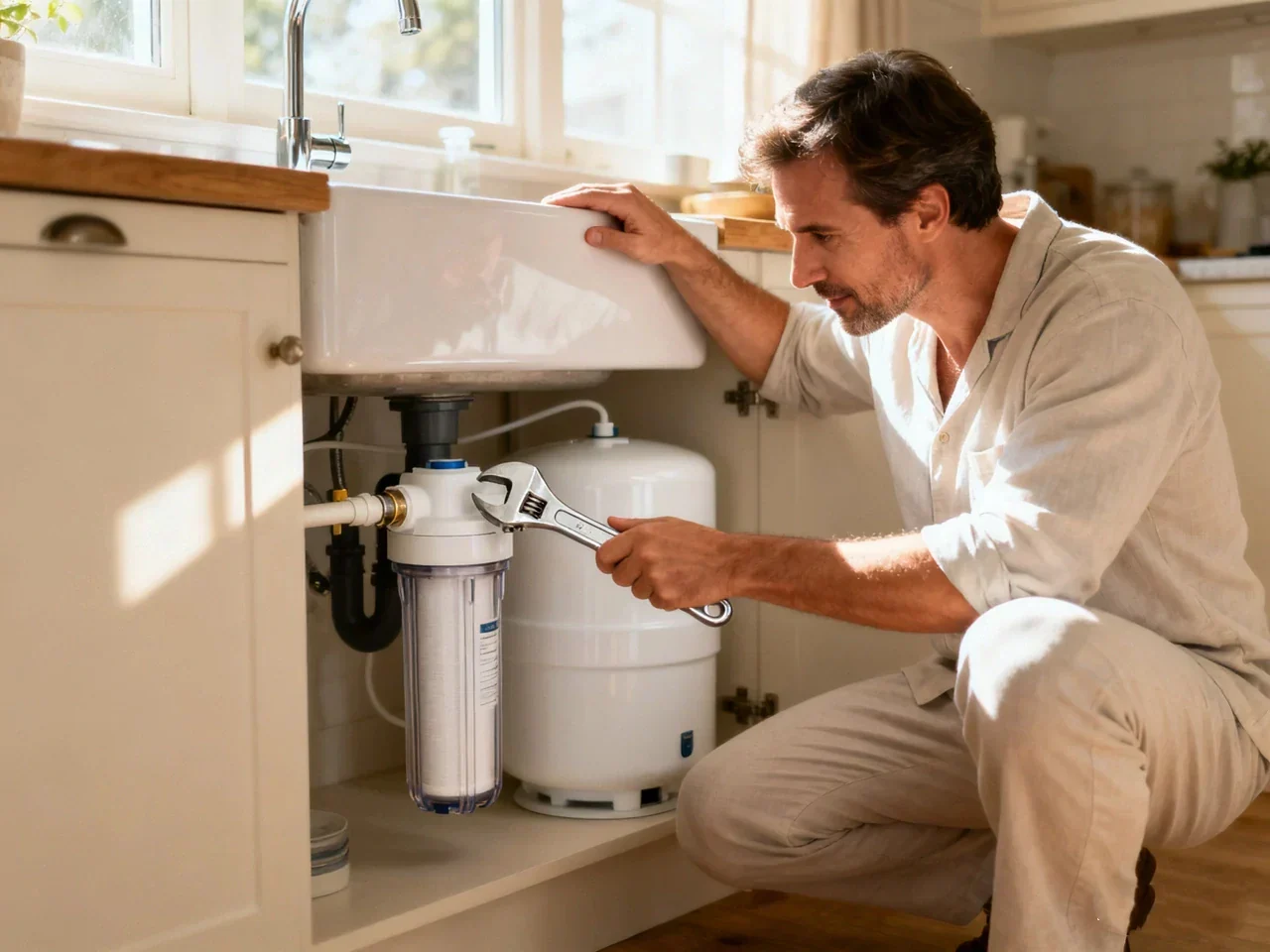
If your main concern is drinking and cooking water, a point-of-use system may be enough. An under-sink filtration system can provide treated water directly at the kitchen faucet without requiring a larger whole-home installation.
Modern under sink filters can use different technologies depending on the desired result. Carbon filtration is commonly used to improve taste and reduce certain substances, while reverse osmosis systems can provide more extensive filtration for drinking water.
This approach can be practical for households that want better drinking water without changing the treatment of water used for showers, laundry, or outdoor activities.
Of course, if hard water is damaging the entire plumbing system, a kitchen filter won’t solve that. It’s important to match the treatment location to the problem.
Whole-Home Treatment Has Its Place
When water concerns affect multiple fixtures, whole-home treatment can be more practical.
A system installed on the main incoming water line can treat water before it reaches bathrooms, kitchens, appliances, and other fixtures. Depending on the technology, it may address hardness, chlorine, sediment, or specific water-quality concerns.
Think about what you’re actually experiencing.
If every showerhead has scale, the problem is clearly bigger than one kitchen faucet. If your only complaint is that drinking water tastes slightly different, a whole-home system might be more than you need.
There’s no prize for choosing the biggest system. The goal is appropriate treatment.
Well Water Requires Extra Attention
Private wells provide a valuable water source, but homeowners are responsible for understanding and monitoring their quality.
Unlike municipal water, well water doesn’t pass through a centralized public treatment system before reaching your home. Its characteristics can be influenced by groundwater conditions, geology, nearby land use, rainfall, and the condition of the well itself.
Good well water treatment therefore starts with testing.
Depending on the results, a well may require sediment filtration, softening, iron removal, carbon filtration, disinfection, or another specialized approach.
A sulfur smell, for example, doesn’t automatically mean you need the same equipment as someone dealing with iron staining. The cause matters.
If your well water suddenly changes in color, smell, taste, or clarity, don’t simply install a random filter and hope for the best. Find out why the change happened.
System Size Matters
Treatment equipment has to keep up with water demand.
A small household with one bathroom doesn’t use water in the same way as a large family with several bathrooms, a washing machine, dishwasher, and frequent guests.
Peak demand matters too. Several showers running at once can create a much higher flow rate than a quiet afternoon.
If a system is too small, it may struggle to perform properly when demand rises. If it’s significantly oversized, you may spend more than necessary.
Proper sizing should consider household size, water usage, flow rate, water chemistry, and the type of treatment being used.
Maintenance Is Part of the Deal
Even a well-designed system needs attention.
Filters eventually become exhausted. Water softeners need salt or other maintenance. Reverse osmosis membranes require replacement. Certain systems need periodic inspection or cleaning.
Before buying equipment, ask about the maintenance schedule and ongoing costs.
How often do filters need replacement? Are replacement parts readily available? Does the system require professional servicing? What happens if something fails?
These questions aren’t exciting, admittedly, but they’re important.
A system that’s easy to maintain is much more likely to perform well for years.
Choose the System Around Your Life
The right water treatment system should fit your water and your routine.
Start with testing. Identify the actual concern. Decide whether you need treatment throughout the home or only at a specific faucet. Then compare systems based on capacity, maintenance, operating costs, and long-term usefulness.
Don’t be distracted by complicated features that don’t solve a real problem.
Good water treatment is often surprisingly simple when the decision is based on solid information. Maybe it’s a softener. Maybe it’s an under-sink filter. Maybe your well needs a combination of technologies.
Whatever the answer turns out to be, the goal is the same: water that works better for your home, without creating another headache to manage.
And really, that’s what good home improvement should do — make everyday life a little easier, quietly and reliably.